e8b9dbff2f
issue: #51253

> Rebased on master after #51254 merged. The `db_name`/`db_id` part of
the original PR is now covered by #51254; this PR is reduced to the two
remaining gaps on the same query-by-id path.

## Problem

When `DescribeCollection` is called with **only a `collectionID`** — no
collection name, no db name (e.g. the HTTP management API on `:9091`) —
two gaps remain after #51254:

1. **Top-level `collection_name` is empty** on both the cached provider
path and the `describeCollectionTask` path. The response is initialized
from the (empty) `request.CollectionName` before the name is resolved,
and never backfilled.
2. **The cached provider discards the caller-provided collection id.**
After deriving the name from the id, it re-resolves the id from that
name via `GetCollectionID(db, name)`. Id-only lookups are cached under
the request db name — empty here — so with same-name collections in
different databases, a concurrent cache refresh can rebind the entry
under the `""` key and the request would silently describe the wrong
collection (the derived name matches, the id does not).

## Fix

- `service_provider.go`:
- Backfill `resp.CollectionName` from the resolved cached schema when
the request carried no name. Requests that pass a name (including
aliases) still echo it unchanged.
- Skip the name→id re-resolution when the caller already supplied the
id. `GetCollectionInfo` already validates the cache entry against the id
(`collInfo.collID != collectionID` → refresh by id), so the
caller-provided id is authoritative end to end. Name+id requests keep
the existing name-precedence behavior.
- Resolve identifiers on local copies instead of rewriting
`request.CollectionName`/`CollectionID` in place — the access log
interceptor and the success metric labels serialize the request after
the handler returns, and previously recorded the resolved values instead
of what the client sent.
- `task.go`: backfill `t.result.CollectionName` from the coordinator
result on the non-cached path.
- `meta_cache.go`: fix a stale comment on `ResolveCollectionAlias` —
`update()` now always keys `collInfo` by the real collection name
(aliases live in the separate alias map), the old comment described
pre-refactor behavior.
- Tests:
-
`TestCachedProxyServiceProvider_DescribeCollection_ByIDFillsNameAndUsesRequestID`:
drives the id-only path; `GetCollectionID` is deliberately not mocked,
so any regression back to re-resolving the id panics the test.
- `TestDescribeCollectionTask_FillsNameFromResultWhenQueriedByID`: same
assertion for the non-cached path.
- Removed the now-unused `GetCollectionID` expectation from the test
added in #51254 (that call no longer happens on the id-only path).

## Follow-up commit: entity-keyed meta cache with a cluster-wide id
index

Reviewing this path surfaced a deeper issue in the proxy meta cache,
fixed in the second commit:

- By-id lookups (`GetCollectionName`, `GetCollectionInfo` with an empty
name) linearly scanned a whole db bucket under the read lock, on every
request even on cache hits.
- The bucket scanned/filled was keyed by the *request* db name — empty
for id-only calls — so entries landed in a bogus `""` bucket: a
collection also cached under its real db was duplicated, and same-name
collections of different databases evicted each other from the single
`""`-keyed slot.

The cache is now entity-keyed instead of request-keyed:

- Fills land under the collection's **actual database** (carried in the
describe response); the `""` bucket no longer exists.
- A cluster-wide `collectionID → entry` index serves by-id lookups in
**O(1)** regardless of the request db — matching rootcoord, which
resolves by-id describes straight from `collID2Meta` without consulting
the db name.
- Name lookups normalize an empty db name to `default`, mirroring
rootcoord's backward-compat normalization
(`meta_table.getCollectionByNameInternal`). This also closes a latent
cross-database mis-hit: a name lookup with an empty db could previously
return whichever same-name collection was last id-cached under the `""`
bucket.
- All removal paths maintain the index (pointer-identity-guarded
unindexing); invalidation sweeps stay exhaustive.

## Verification

- Ran locally against a current master core build: the full
`TestMetaCache*`, `TestCachedProxyServiceProvider*`,
`TestDescribeCollectionTask*`, alias and partition test sets all pass,
plus the **full `internal/proxy` suite** (only the pre-existing
etcd-dependent `TestProxyRpcLimit` fails locally — it needs a live etcd,
unrelated to this change).
- New tests:
`TestCachedProxyServiceProvider_DescribeCollection_ByIDFillsNameAndUsesRequestID`
(id-only path; also asserts the request is not rewritten),
`TestDescribeCollectionTask_FillsNameFromResultWhenQueriedByID`,
`TestMetaCache_ByIDIndexRealDBBucket` (same-name collections in two
databases filled by id: no eviction, entries under real dbs, by-name
reuses by-id fill, every removal path cleans the index),
`TestMetaCache_EmptyDBNameSharesDefaultEntry`.

🤖 Generated with [Claude Code](https://claude.com/claude-code)


---

## Update: proxy meta cache rebuilt around an id-primary store (2 new
commits)

Following review discussions on invalidation cost and the alias-DDL
races, this PR now also rebuilds the cache (issue: #51533, design doc:
`docs/design-docs/design_docs/20260716-proxy-metacache-id-inverted-index.md`
in this PR):

1. **`fix: forward the pre-alter alias target id in the AlterAlias
expiration`** — rootcoord resolves the pre-alter target under its
database lock and carries it in the new additive
`AlterAliasMessageHeader.old_collection_id`; the ack callback emits a
second expiration entry so proxies evict BOTH AlterAlias targets by id.
Closes the race where a concurrent Describe re-points the proxy's alias
resolution before the expiration arrives, leaving the old target
permanently stale. Older rootcoords (field 0) fall back to the proxy's
hint resolution.
2. **`enhance: rebuild the proxy meta cache around an id-primary
store`** — the primary store is keyed by the cluster-unique collection
id (single source of truth, with a per-database generation); name/alias
resolution become hints validated against the primary on read; partition
caches are keyed by id; fills are ordered against invalidations by a
fill RWMutex (drain in-flight describes before evicting), replacing the
per-collection timestamp floor. Every invalidation becomes O(1) — no
more full-cache scans under the write lock on
Load/Release/Drop/Rename/Alter broadcasts, and
DropDatabase/AlterDatabase becomes a generation bump. Also removes a
latent stale read (alias-keyed partition entries surviving
DropCollection).

Verification: targeted cache suites green (rename, alias re-point under
concurrent describe, drop+recreate with a reused name, db-generation
invalidation, cross-db isolation, gated-mock fill/invalidation
ordering); three negative controls (hint validation / dbGen check / fill
drain disabled) each fail exactly the test guarding them; full-package
`-race` delegated to CI.


---

## Update: simplification series (final form)

Following design review, the cache was iteratively simplified to an
**id-primary store with declared hints** — every mechanism that could be
replaced by an invariant was deleted (net-negative diffs throughout):

- Primary store keyed by the cluster-unique collection id; liveness IS
presence. Name/alias resolution are hints written ONLY together with
their entry (declared aliases) and validated against the primary on
every read — a stale hint can only cost one extra describe, never a
stale read.
- Fill/invalidation ordering via a fill RWMutex (drain in-flight
describes before evicting); the per-collection timestamp floor, database
generations, background GC, alias negative cache, per-partition cache,
and the resolve-and-forget DescribeAlias path are all **deleted**.
Evictions clean everything the entry owns synchronously; **no
invalidation path performs any RPC**.
- Old-rootcoord fallbacks: id-describes without DbName are served
uncached; alias-DDL broadcasts without ids trigger hint resolution plus
a holder scan **gated on that exact fingerprint** (dead code once
rootcoords are upgraded), closing the ghost-alias case with no healing
event.
- **Accepted gaps (WONT-FIX)** are recorded in the design doc §6 —
notably the upgrade-window new-target `Aliases` display lag (the
association exists only at rootcoord; self-heals on first use;
display-only).

See
`docs/design-docs/design_docs/20260716-proxy-metacache-id-inverted-index.md`
for the full design, invariants and trade-offs.

Signed-off-by: xiaofanluan <xf@hjjaq.com>
Co-authored-by: xiaofanluan <xf@hjjaq.com>
Co-authored-by: Claude Opus 4.8 (1M context) <noreply@anthropic.com>








What is Milvus?
🐦 Milvus is a high-performance vector database built for scale. It powers AI applications by efficiently organizing and searching vast amounts of unstructured data, such as text, images, and multi-modal information.
🧑💻 Written in Go and C++, Milvus implements hardware acceleration for CPU/GPU to achieve best-in-class vector search performance. Thanks to its fully-distributed and K8s-native architecture, Milvus can scale horizontally, handle tens of thousands of search queries on billions of vectors, and keep data fresh with real-time streaming updates. Milvus also supports Standalone mode for single machine deployment. Milvus Lite is a lightweight version good for quickstart in python with pip install.
Want to use Milvus with zero setup? Try out Zilliz Cloud ☁️ for free. Milvus is available as a fully managed service on Zilliz Cloud, with Serverless, Dedicated and BYOC options available.
For questions about how to use Milvus, join the community on Discord to get help. For reporting problems, file bugs and feature requests in GitHub Issues or ask in Discussions.
The Milvus open-source project is under LF AI & Data Foundation, distributed with Apache 2.0 License, with Zilliz as its major contributor.
Quickstart
$ pip install -U pymilvus
This installs pymilvus, the Python SDK for Milvus. Use MilvusClient to create a client:
from pymilvus import MilvusClient
-
You can also try Milvus Lite for quickstart by installing
pymilvus[milvus-lite]. To create a local vector database, simply instantiate a client with a local file name for persisting data:client = MilvusClient("milvus_demo.db") -
You can also specify the credentials to connect to your deployed Milvus server or Zilliz Cloud:
client = MilvusClient(
  uri="<endpoint_of_self_hosted_milvus_or_zilliz_cloud>",
  token="<username_and_password_or_zilliz_cloud_api_key>")
With the client, you can create collection:
client.create_collection(
    collection_name="demo_collection",
    dimension=768,  # The vectors we will use in this demo have 768 dimensions
)
Ingest data:
res = client.insert(collection_name="demo_collection", data=data)
Perform vector search:
query_vectors = embedding_fn.encode_queries(["Who is Alan Turing?", "What is AI?"])
res = client.search(
    collection_name="demo_collection",  # target collection
    data=query_vectors,  # a list of one or more query vectors, supports batch
    limit=2,  # how many results to return (topK)
    output_fields=["vector", "text", "subject"],  # what fields to return
)
Why Milvus
Milvus is designed to handle vector search at scale. It stores vectors, which are learned representations of unstructured data, together with other scalar data types such as integers, strings, and JSON objects. Users can conduct efficient vector search with metadata filtering or hybrid search. Here are why developers choose Milvus as the vector database for AI applications:
High Performance at Scale and High Availability
- Milvus features a distributed architecture that separates compute and storage. Milvus can horizontally scale and adapt to diverse traffic patterns, achieving optimal performance by independently increasing query nodes for read-heavy workload and data node for write-heavy workload. The stateless microservices on K8s allow quick recovery from failure, ensuring high availability. The support for replicas further enhances fault tolerance and throughput by loading data segments on multiple query nodes. See benchmark for performance comparison.
Support for Various Vector Index Types and Hardware Acceleration
- Milvus separates the system and core vector search engine, allowing it to support all major vector index types that are optimized for different scenarios, including HNSW, IVF, FLAT (brute-force), SCANN, and DiskANN, with quantization-based variations and mmap. Milvus optimizes vector search for advanced features such as metadata filtering and range search. Additionally, Milvus implements hardware acceleration to enhance vector search performance and supports GPU indexing, such as NVIDIA's CAGRA.
Flexible Multi-tenancy and Hot/Cold Storage
- Milvus supports multi-tenancy through isolation at database, collection, partition, or partition key level. The flexible strategies allow a single cluster to handle hundreds to millions of tenants, also ensures optimized search performance and flexible access control. Milvus enhances cost-effectiveness with hot/cold storage. Frequently accessed hot data can be stored in memory or on SSDs for better performance, while less-accessed cold data is kept on slower, cost-effective storage. This mechanism can significantly reduce costs while maintaining high performance for critical tasks.
Sparse Vector for Full Text Search and Hybrid Search
- In addition to semantic search through dense vector, Milvus also natively supports full text search with BM25 as well as learned sparse embeddings such as SPLADE and BGE-M3. Users can store sparse vectors and dense vectors in the same collection, and define functions to rerank results from multiple search requests. See examples of Hybrid Search with semantic search + full text search.
Data Security and Fine-grain Access Control
- Milvus ensures data security by implementing mandatory user authentication, TLS encryption, and Role-Based Access Control (RBAC). User authentication ensures that only authorized users with valid credentials can access the database, while TLS encryption secures all communications within the network. Additionally, RBAC allows for fine-grained access control by assigning specific permissions to users based on their roles. These features make Milvus a robust and secure choice for enterprise applications, protecting sensitive data from unauthorized access and potential breaches.
Milvus is trusted by AI developers to build applications such as text and image search, Retrieval-Augmented Generation (RAG), and recommendation systems. Milvus powers many mission-critical businesses for startups and enterprises.
Demos and Tutorials
Here is a selection of demos and tutorials to show how to build various types of AI applications made with Milvus:
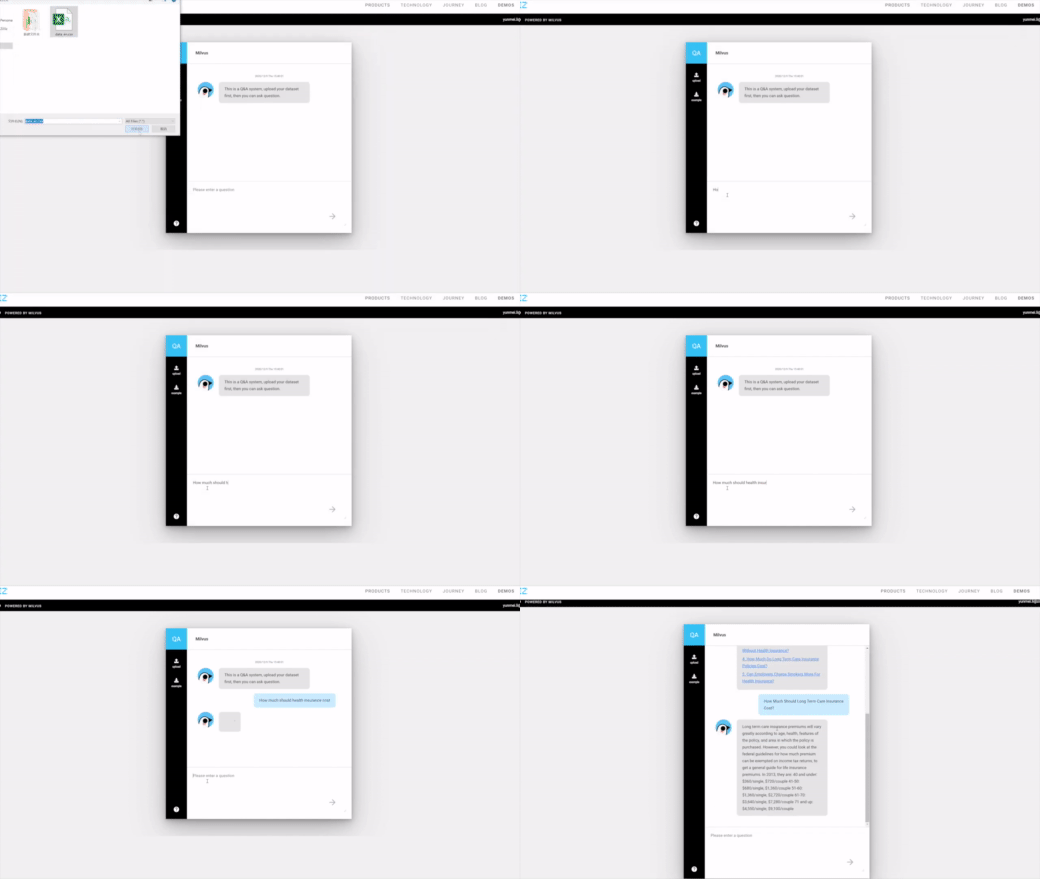
You can explore a comprehensive Tutorials Overview covering topics such as Retrieval-Augmented Generation (RAG), Semantic Search, Hybrid Search, Question Answering, Recommendation Systems, and various quick-start guides. These resources are designed to help you get started quickly and efficiently.
| Tutorial | Use Case | Related Milvus Features |
|---|---|---|
| Build RAG with Milvus | RAG | vector search |
| Advanced RAG Optimizations | RAG | vector search, full text search |
| Full Text Search with Milvus | Text Search | full text search |
| Hybrid Search with Milvus | Hybrid Search | hybrid search, multi vector, dense embedding, sparse embedding |
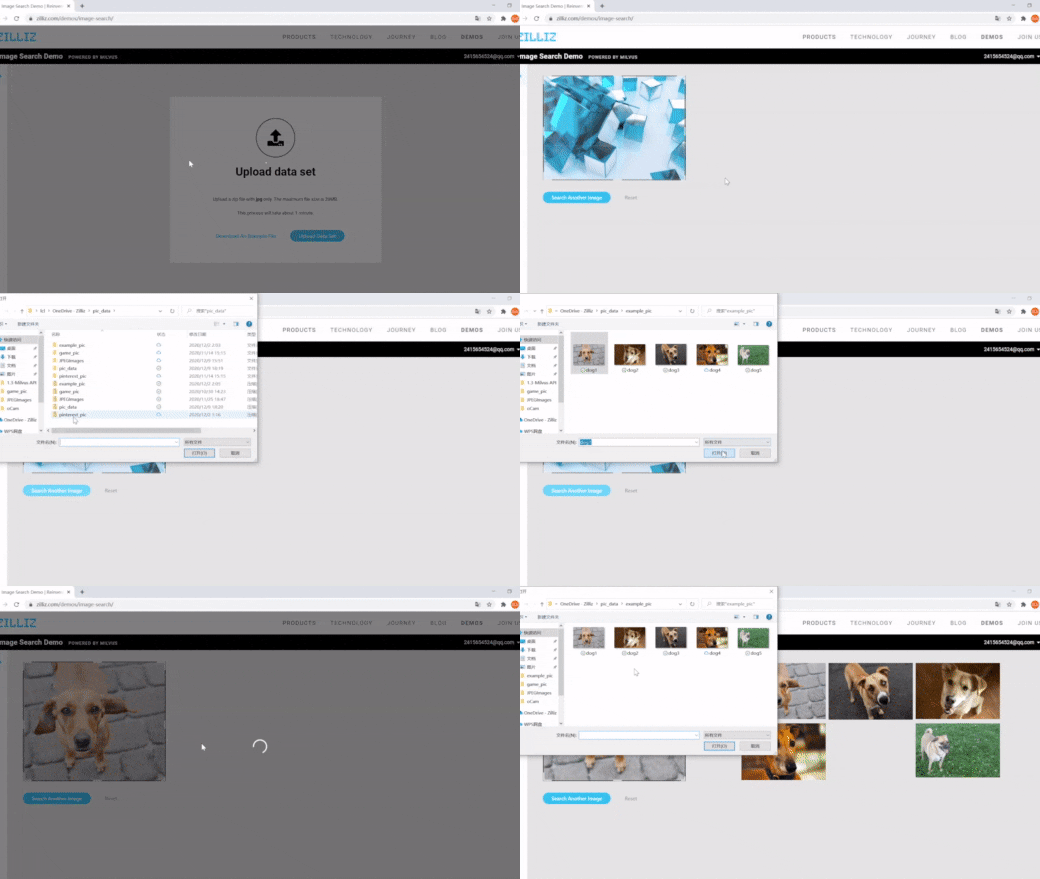
| Image Search with Milvus | Semantic Search | vector search, dynamic field |
| Multimodal Search using Multi Vectors | Semantic Search | multi vector, hybrid search |
| Movie Recommendation with Milvus | Recommendation System | vector search |
| Graph RAG with Milvus | RAG | graph search |
| Contextual Retrieval with Milvus | Quickstart | vector search |
| Vector Visualization | Quickstart | vector search |
| HDBSCAN Clustering with Milvus | Quickstart | vector search |
| Use ColPali for Multi-Modal Retrieval with Milvus | Quickstart | vector search |
|
|
|
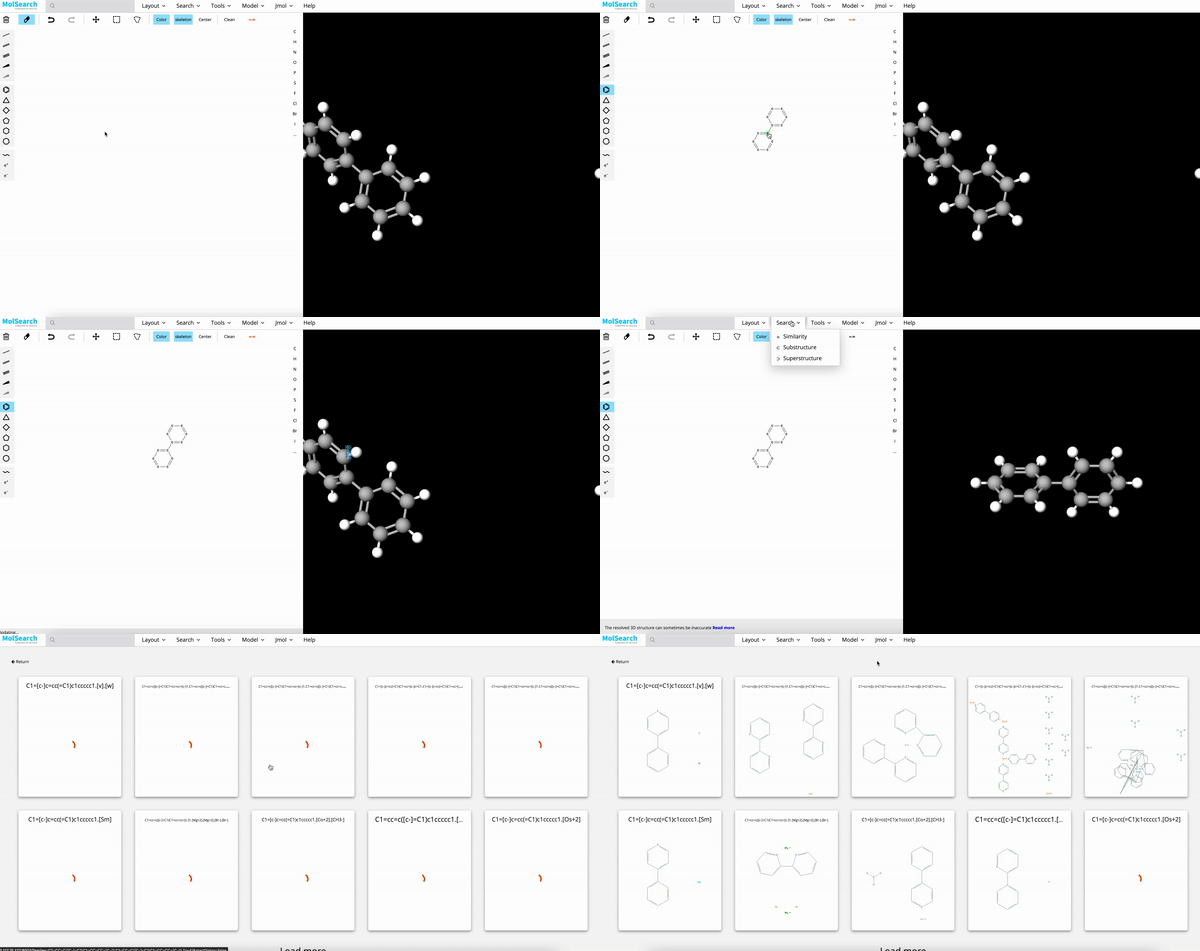
| Image Search | RAG | Drug Discovery |
|---|
Ecosystem and Integration
Milvus integrates with a comprehensive suite of AI development tools, such as LangChain, LlamaIndex, OpenAI and HuggingFace, making it an ideal vector store for GenAI applications such as Retrieval-Augmented Generation (RAG). Milvus works with both open-source embedding models and embedding services, in text, image and video modalities. Milvus also provides a convenient utility pymilvus[model], users can use the simple wrapper code to transform unstructured data into vector embeddings and leverage reranking models for optimized search results. The Milvus ecosystem also includes Attu for GUI-based administration, Birdwatcher for system debugging, Prometheus/Grafana for monitoring, Milvus CDC for data synchronization, VTS for data migration and data connectors for Spark, Kafka, Fivetran, and Airbyte to build search pipelines.
Check out https://milvus.io/docs/integrations_overview.md for more details.
Documentation
For guidance on installation, usage, deployment, and administration, check out Milvus Docs. For technical milestones and enhancement proposals, check out issues on GitHub.
Contributing
The Milvus open-source project accepts contributions from everyone. See Guidelines for Contributing for details on submitting patches and the development workflow. See our community repository to learn about project governance and access more community resources.
Build Milvus from Source Code
Requirements:
-
Linux systems (Ubuntu 20.04 or later recommended):
Go: >= 1.21 CMake: >= 3.26.4 && CMake < 4 GCC: >= 11 Python: > 3.8 and <= 3.11 -
MacOS systems with x86_64 (Big Sur 11.5 or later recommended):
Go: >= 1.21 CMake: >= 3.26.4 && CMake < 4 llvm: >= 15 Python: > 3.8 and <= 3.11 -
MacOS systems with Apple Silicon (Monterey 12.0.1 or later recommended):
Go: >= 1.21 (Arch=ARM64)
CMake: >= 3.26.4 && CMake < 4
llvm: >= 15
Python: > 3.8 and  <= 3.11
Clone Milvus repo and build.
# Clone github repository.
$ git clone https://github.com/milvus-io/milvus.git

# Install third-party dependencies.
$ cd milvus/
$ ./scripts/install_deps.sh

# Compile Milvus.
$ make
For full instructions, see developer's documentation.
Community
Join the Milvus community on Discord to share your suggestions, advice, and questions with our engineering team.
To learn the latest news about Milvus, follow us on social media:
You can also check out our FAQ page to discover solutions or answers to your issues or questions, and subscribe to Milvus mailing lists:
Reference
Reference to cite when you use Milvus in a research paper:
@inproceedings{2021milvus,
  title={Milvus: A Purpose-Built Vector Data Management System},
  author={Wang, Jianguo and Yi, Xiaomeng and Guo, Rentong and Jin, Hai and Xu, Peng and Li, Shengjun and Wang, Xiangyu and Guo, Xiangzhou and Li, Chengming and Xu, Xiaohai and others},
  booktitle={Proceedings of the 2021 International Conference on Management of Data},
  pages={2614--2627},
  year={2021}
}

@article{2022manu,
  title={Manu: a cloud native vector database management system},
  author={Guo, Rentong and Luan, Xiaofan and Xiang, Long and Yan, Xiao and Yi, Xiaomeng and Luo, Jigao and Cheng, Qianya and Xu, Weizhi and Luo, Jiarui and Liu, Frank and others},
  journal={Proceedings of the VLDB Endowment},
  volume={15},
  number={12},
  pages={3548--3561},
  year={2022},
  publisher={VLDB Endowment}
}